Away All Day? How to Choose an Automatic Feeder and Water Setup for Your Cats and Dogs
A 7 a.m. breakfast and a 7 p.m. dinner is easy on paper. Then a meeting runs late, the train stalls, or a work trip lands on the calendar. An automatic feeder solves the timing. A camera solves the worry. The harder part is picking a setup that fits the pets you actually have.
The short answer: match the feeder to your household first, then choose features. One cat, two pets, and a large dog need different hoppers, bowls and portion sizes. A camera is worth it if you want proof your pet ate, not just proof the feeder dispensed. And for water, a fountain is about preference and convenience; research hasn’t shown that it reliably makes cats drink more.
Here’s how to work through it.
Step 1: Match the feeder to your household
TABLE 01:What to Look for by Household
| Household | Hopper size | Bowls | Watch for |
|---|---|---|---|
| One cat or small dog | 3–5 L | 1 | Portion accuracy, reliable schedule |
| Two pets eating together | 5–7 L | 2 | Separate outlets, per-bowl portions |
| Large dog | 10 L or more | 1 large | Portion size, kibble up to 20+ mm, cord protection, stable base |
One cat or small dog
A single-bowl feeder with a 3–5L hopper is plenty. Focus on portion accuracy and a reliable schedule over extra capacity.
Two pets eating at the same time
This is where most single-bowl feeders fall short. Two pets crowd one bowl, the faster eater wins, and you can’t tell who ate what. A dual-bowl feeder gives each pet its own outlet so they can eat side by side. Check whether each bowl’s portion can be set separately if your pets need different amounts.
Large dogs
Big dogs need big numbers. Look for a hopper of 10L or more, a portion size that adds up quickly (some feeders dispense as little as 5–10 g a portion, which means dozens of portions per meal for a large breed), and kibble compatibility up to about 20 mm or more. Large dogs are also more likely to chew a power cord or knock a light feeder over, so weight and cord protection matter.
Step 2: Decide what you need the camera to do
A feeder log tells you food was dispensed. A camera tells you your pet showed up and ate. These features decide whether the camera is useful or just a gimmick:
- Field of view or motion tracking. A fixed lens pointed at the bowl misses everything else. A camera that pans or tilts can follow your pet across the room.
- Night vision. Dinner often happens after dark in winter.
- Two-way audio. Some pets respond to their owner’s voice; some ignore it. It’s most useful for anxious pets and for calling a pet over to eat.
- Local storage. Many cameras save video only with a monthly cloud subscription. A microSD slot lets you keep clips without one.
- Privacy controls. A camera in your kitchen should have a way to turn it off, ideally a physical lens cover as well as an app setting.
- Wi-Fi band. Some feeders only connect to 2.4 GHz. Check before you buy if your router is set to 5 GHz only.
Step 3: Plan for the day the power goes out
Scheduled meals only work if the feeder keeps running. Look for a battery backup and a schedule that’s saved on the device, not just in the app. Check what still works on battery power. On some feeders, meals keep coming but the app and camera pause until power returns.
One honest caveat: a feeder handles meals, not emergencies. For overnight trips, someone should still check on your pet in person.
A note on raised bowls for large dogs
Elevated feeders are often sold as more comfortable for big dogs. The evidence is more mixed than the marketing. A study published in the Journal of the American Veterinary Medical Association in 2000 linked raised feeders to a share of bloat (GDV) cases in large and giant-breed dogs, while floor-level bowls were not associated with increased risk. The same study found other factors contributed more strongly.
Raised bowls can still help some dogs, such as those with arthritis in the neck or front legs, or after neck surgery. If your large or giant-breed dog doesn’t have one of those needs, the lower bowl height is the safer default. Ask your vet before raising it.
Water: what a fountain can and can’t do
Cats are often described as preferring moving water, and many owners notice their cat drinks from a running tap. The research is more cautious.
- In a 2010 study of 13 cats in the Journal of Feline Medicine and Surgery, a fountain showed higher measured water intake than a bowl, but urine concentration did not differ, and the authors concluded fountains shouldn’t be relied on to increase intake.
- A 2018 study of 14 cats in the same journal found bowl type had no meaningful effect on how much cats drank overall, although about one in five cats showed a personal preference.
So a fountain isn’t a medical tool. If your vet wants your cat drinking more, ask about other strategies. What a fountain does do well is keep water filtered, circulating and topped up while you’re out, and some cats clearly like it. The practical approach: add a fountain, keep a plain bowl too, and see which one your pet uses.
Corded or cordless?
A corded fountain has to live near an outlet, which often means a kitchen corner next to the food bowl. A cordless, battery-powered fountain can go wherever your pet likes to drink, with no cable for pets to chew. The trade-off is recharging, so check real battery life and whether the fountain only runs when it senses your pet, which saves power.
Putting it together
TABLE 02:A Complete Away-From-Home Setup
| Need | Feature to look for |
|---|---|
| Meals on time | Scheduled feeding saved on the device |
| Proof they ate | Camera with tracking or wide view |
| Evenings and nights | Night vision |
| No surprise fees | Local microSD storage |
| Power cuts | Battery backup |
| Fresh water | Filtered fountain plus a plain bowl |
| Flexible placement | Cordless fountain |
If you’re building your setup with Tikpaws, here’s how our lineup maps to those households:
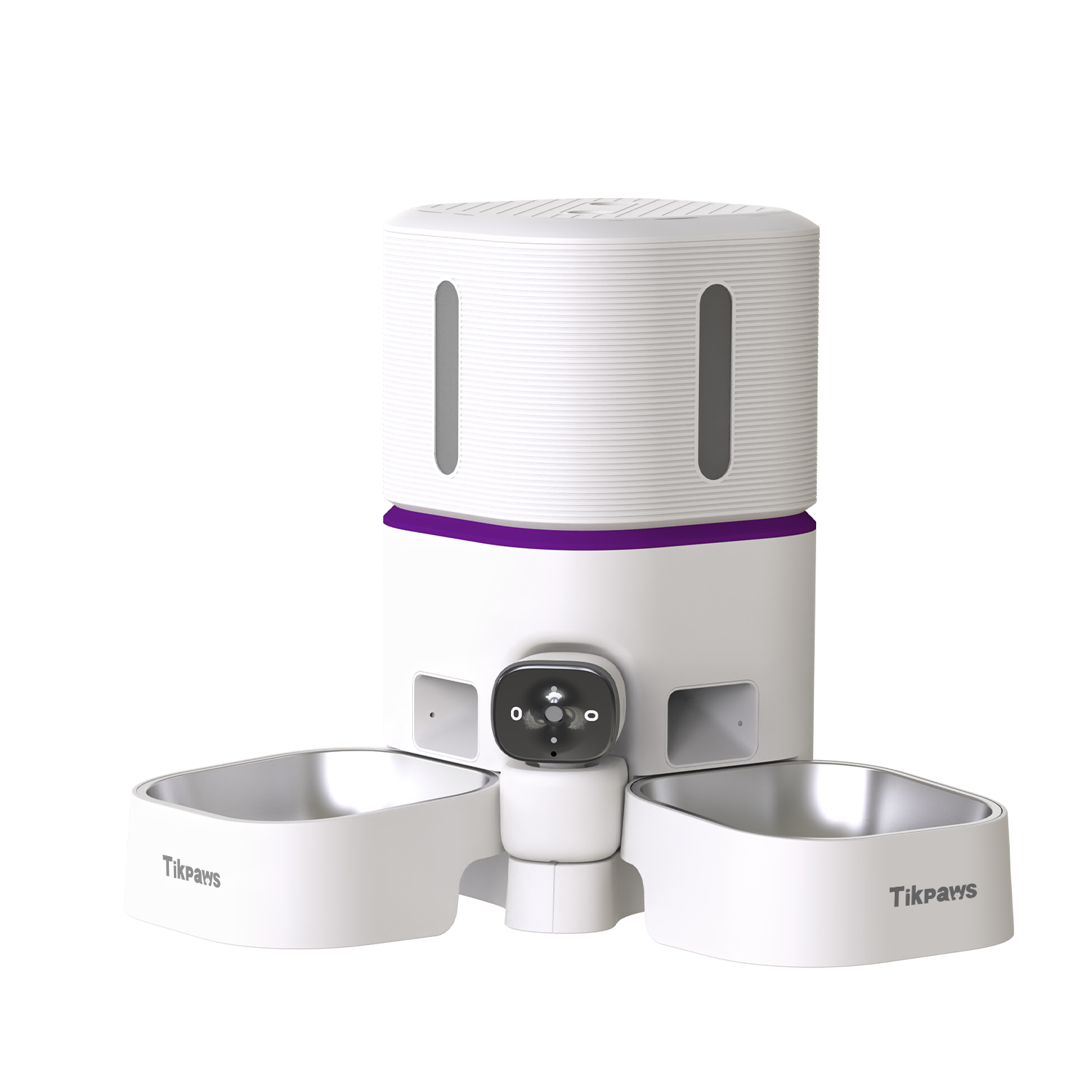
- Two pets: Duet Smart Camera Feeder has two stainless steel bowls, a 7L hopper, a 1080P camera that pans 140° to follow your pet, microSD storage with no subscription, and a 5200mAh backup battery.
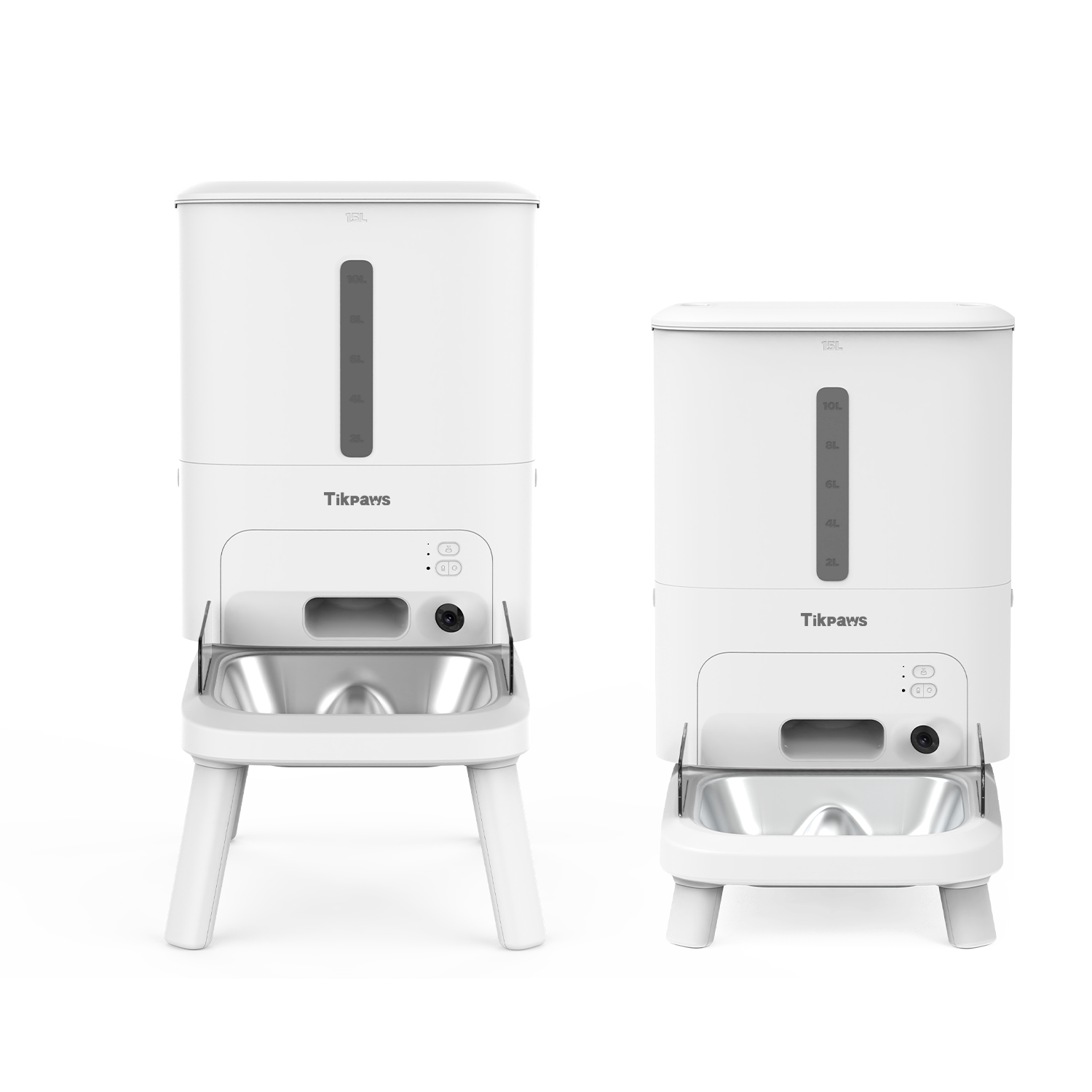
- Large dogs: Atlas 15L Smart Camera Feeder holds 15L, fits kibble from 3 to 23 mm, has night vision and two-way talk, and runs on backup batteries for up to about 30 days. It includes both a 4 in and an 8 in leg set, so you can keep the bowl low unless your vet recommends otherwise.
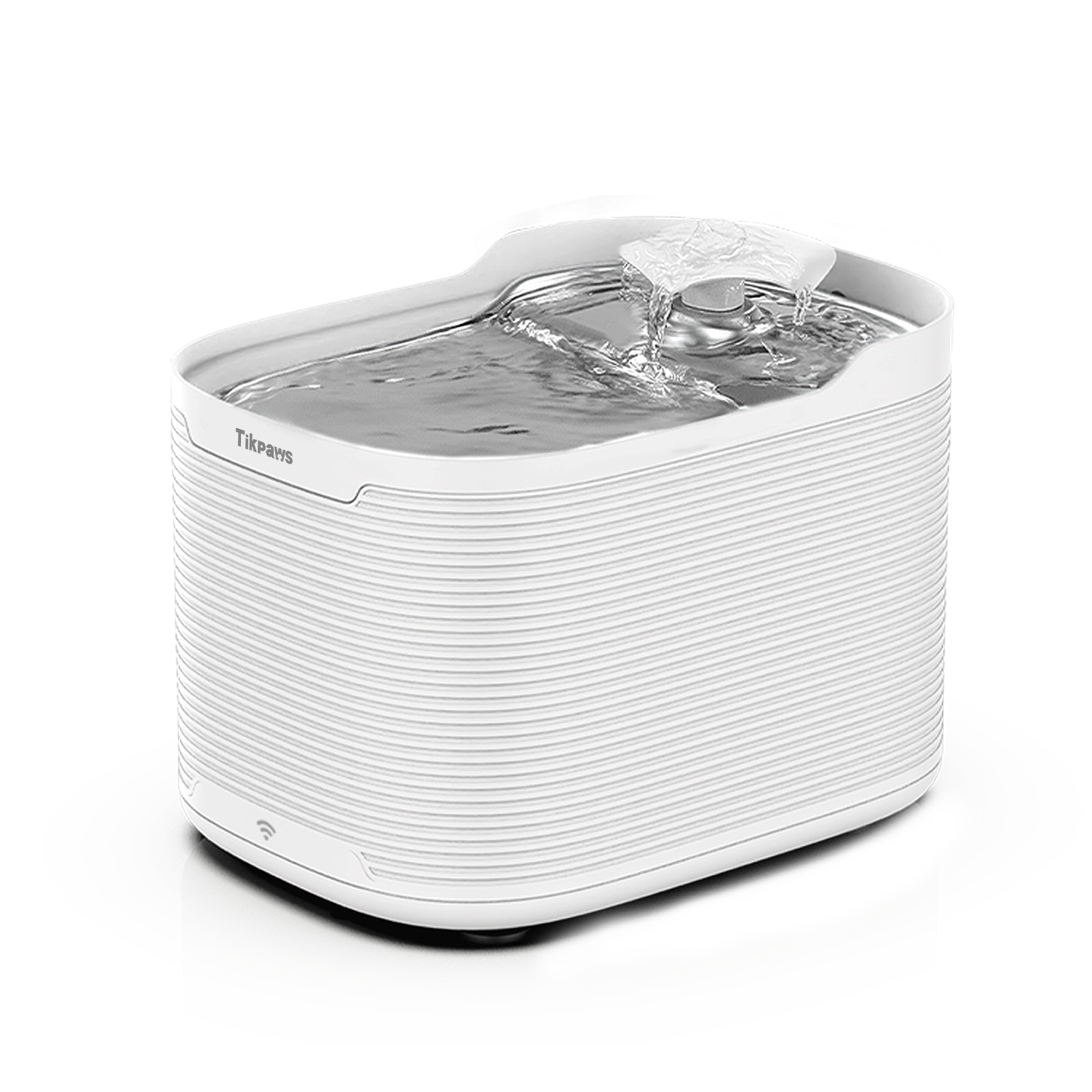
- Water anywhere: Roam Smart Cordless Fountain runs on a 5200mAh battery, starts flowing when it senses your pet, and tracks drinking in the app.
FAQ
Are automatic pet feeders with cameras worth it? They’re worth it if you want to confirm your pet actually ate, not just that food was dispensed. Look for local video storage so you don’t need a subscription.
Can two cats share one automatic feeder? They can, but a single bowl often leads to one cat eating more. A dual-bowl feeder lets both eat at once.
How much food does a large dog feeder need to hold? A large dog eating 4 cups a day goes through about 1 liter of kibble daily. A 10–15L hopper covers roughly one to two weeks, depending on the food.
Are elevated bowls good for large dogs? Not by default. A 2000 study linked raised feeders to some bloat cases in large and giant breeds. Raised bowls may help dogs with neck or front-leg arthritis. Ask your vet.
Do cats drink more from a water fountain? Studies haven’t shown a reliable increase. Some cats prefer fountains, so offering both a fountain and a bowl is a good approach.
What happens to an automatic feeder in a power outage? Feeders with battery backup keep dispensing scheduled meals. App control and video may pause until power returns.